Robot control model anticipates motion without generating future video
A preprint describes a vision-language-action model that learns compact physical tokens about how scenes will change, sidestepping the delay of generating video.
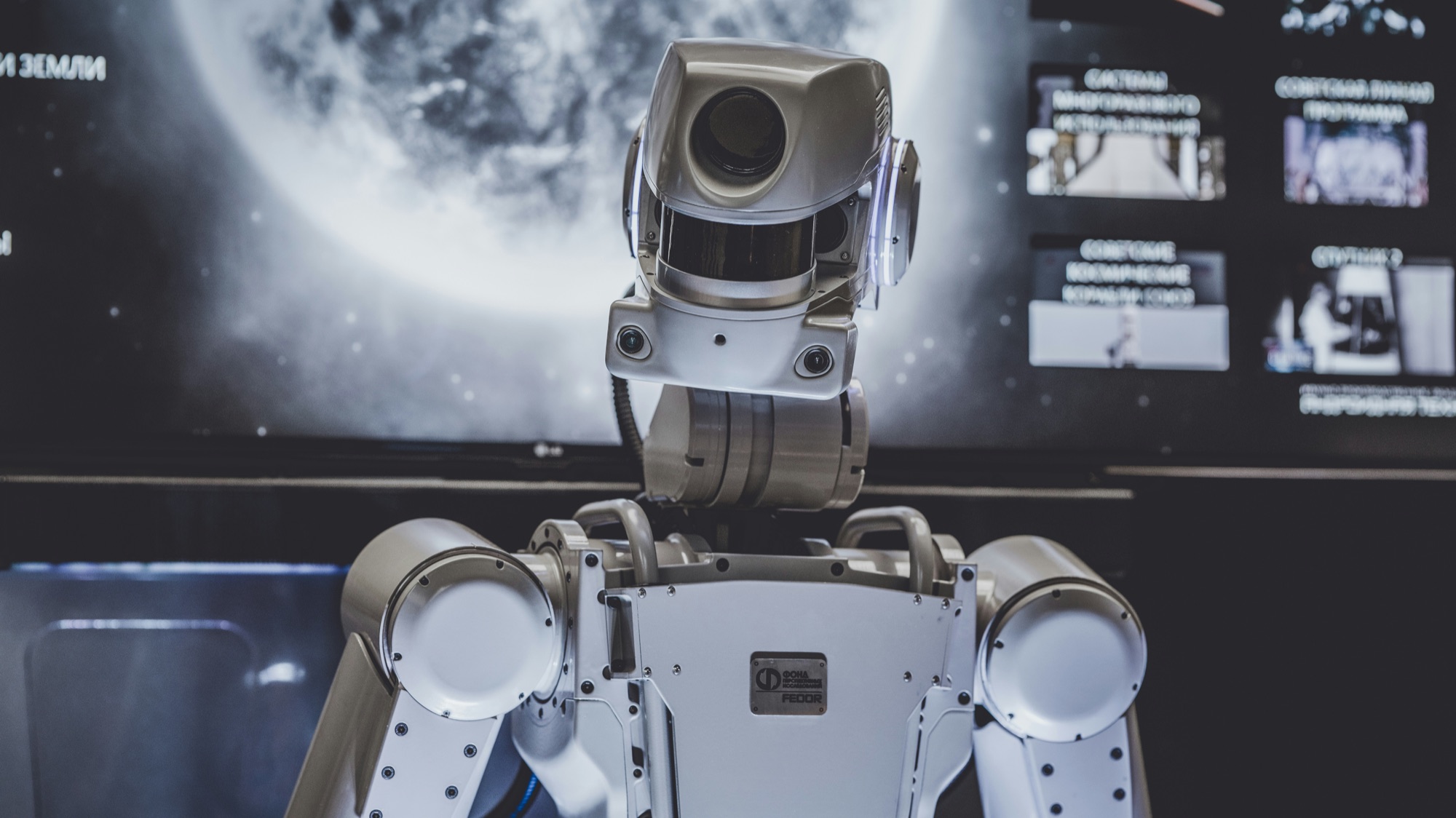
Robots that act on written instructions need some sense of how the world will change once they move. A new study proposes a cheap way to give them that sense. Instead of generating a video of the future at every step, its model condenses predictions about upcoming motion into a small set of internal signals that steer the robot's actions. The work, by Hanqing Wang and colleagues, is a preprint posted on arXiv and has not yet been peer reviewed. All of its reported results come from simulated environments rather than physical robots.
The system belongs to a family known as vision-language-action (VLA) models, which take camera images and a language instruction and produce commands for a robot. According to the authors, such models still have a limited understanding of physical dynamics, meaning how things in a scene move and change over time. One way to fill that gap is a video world model, a generative system that predicts what a scene will look like next. The drawback, the authors note, is that generating future video is slow. That delay lands inside the control loop, the repeating cycle in which a robot observes, decides and acts.
Their model, PDRVLA, adds what the authors describe as a lightweight Physical Dynamics Module. It takes the visual and language features the model already computes and extracts physical tokens, compact numerical summaries that condition how actions are generated. No video is produced while the robot is operating. To teach the module what to capture, the team trains it to predict features of the future scene directly. These are the scene's colour image, its depth (how far each point lies from the camera) and its optical flow (the apparent motion of each part of the image from one moment to the next). A pretrained video world model provides additional guidance during training. It is kept frozen, so its own internal settings are not altered.
Training relied entirely on publicly available data, which the authors expanded in three ways. The first is a process they call human-to-robot synthesis. The second is a set of annotations that break tasks into subtasks. The third is embodied chain-of-thought annotation, a form of step-by-step written reasoning tied to what the robot is doing. The authors tested the model on four simulation benchmarks, which are standardised suites of robot tasks. They report success rates of 99.3% on LIBERO, 89.9% on LIBERO-Plus, 93.6% on RoboTwin 2.0 and 81.5% on SimplerEnv. They also ran ablations, experiments that remove or change one ingredient at a time. According to the study, supervision from the world model improved the module's predictions of the future. The ablations also examined how three other ingredients affect how often actions succeed: subtask conditioning, supervision on where objects will be positioned and oriented, and chain-of-thought training.
Several questions remain open on the evidence of the abstract. The benchmarks are all simulations, so how the approach fares on real robots is not addressed. The abstract does not say how these scores compare with those of other models. Nor does it put a figure on how much latency is saved by avoiding video generation. And although the ablations measure the effect of each training ingredient, the abstract does not say which ones mattered most.
- Paper
- PDRVLA: A Vision-Language-Action Model with Physical Dynamics Representations
- Authors
- Hanqing Wang, Zhaotian Cai, Ruichuan An, Bohan Zeng, Tao Zhang, Yilin Chen et al.
- Venue
- arXiv preprint — not yet peer reviewed · 27 October 2026
- Link
- arxiv.org/abs/2610.37381