Spin-split electron bands seen in MnTe, a magnet with vanishing net magnetisation
Photoemission experiments on manganese telluride, checked against calculations, show the spin splitting predicted for altermagnets, a proposed third kind of collinear magnet.
In a 2024 paper in Nature, Juraj Krempaský, Libor Šmejkal and colleagues, from institutions including the Paul Scherrer Institute and the Czech Academy of Sciences, report photoemission measurements on manganese telluride (MnTe). MnTe is a magnet whose atomic moments cancel, leaving essentially no net magnetisation. The team finds that its electron bands are nonetheless split by spin: electrons with the same momentum but opposite spins sit at different energies. The authors present this as direct confirmation, in the band structure itself, of altermagnetism. Altermagnets are a proposed third class of collinear magnet (one whose moments all lie along a single axis), alongside ferromagnets and antiferromagnets.
This kind of spin splitting is what spintronic devices exploit. Ordinary non-magnetic crystals do not show it if they are centrosymmetric, meaning they look the same when every point is reflected through a centre. In such crystals each energy level holds two opposite spins at exactly the same energy, a pairing called Kramers spin degeneracy. Splitting that pairing has traditionally been explained in two ways. One is the net magnetisation of a ferromagnet, a strong effect rooted in the exchange interaction. The other is spin–orbit coupling, a relativistic link between an electron's spin and its motion that is strongest in heavy atoms, acting in crystals that lack inversion symmetry; this second effect is generally weaker. An altermagnet would combine ferromagnet-like spin splitting with an antiferromagnet's zero net magnetisation, and MnTe is the test case.
How it works
The argument starts with symmetry. Below 310 K, the manganese atoms in α-MnTe form two sublattices with opposite moments. The crystal is hexagonal and keeps its inversion symmetry. In a conventional antiferromagnet, the two opposite-spin sublattices are related either by a simple shift or by inversion. Shift-linked sublattices produce spin-split bands only when spin–orbit coupling acts and inversion symmetry is broken. Inversion-linked ones stay degenerate even with spin–orbit coupling. In MnTe the sublattices are related instead by a sixfold screw rotation, a turn about an axis combined with a partial shift along it. Spin-group symmetry theory predicts that this relationship lets the bands split by spin without any net magnetisation.
The predicted splitting is not uniform. For MnTe, theory gives what physicists call a g-wave pattern with four nodal planes. These are planes in momentum space where, without spin–orbit coupling, spin-up and spin-down bands stay at the same energy. Three are vertical planes running through the high-symmetry points Γ (the centre of momentum space) and K. The fourth is the plane kz = 0, where kz is the electron's momentum perpendicular to the sample surface. The authors separate two effects. Outside the nodal planes, 'strong' altermagnetic splitting comes from the magnetic order alone and needs no spin–orbit coupling. Inside them, 'weak' splitting appears because spin–orbit coupling lifts the degeneracy, even though the crystal keeps its inversion symmetry.
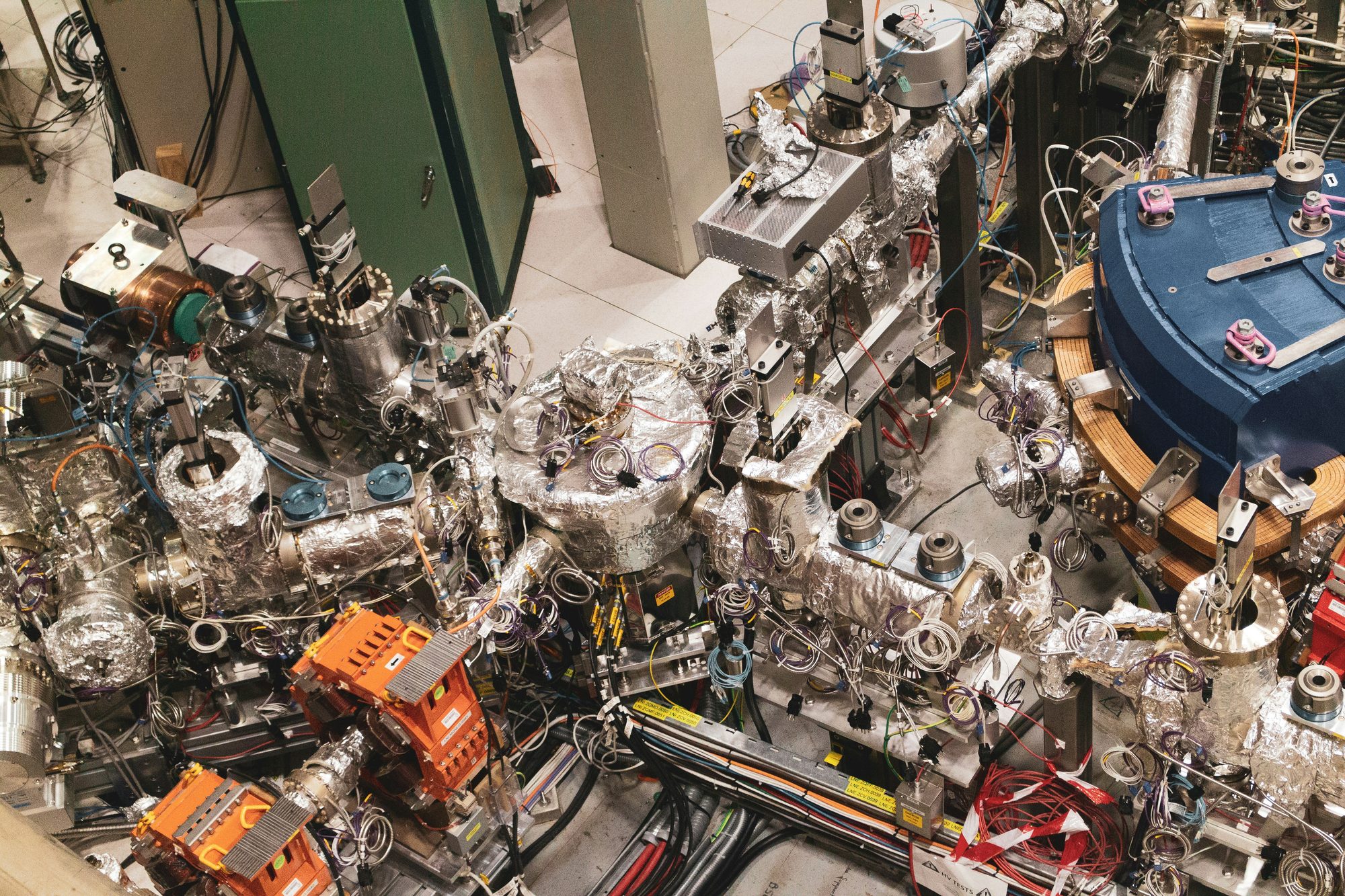
To see the bands, the team used angle-resolved photoemission spectroscopy (ARPES). In ARPES, light knocks electrons out of a sample, and their energies and angles map the band structure. The team used soft X-rays of 350–700 eV on 200-nanometre MnTe films grown by molecular-beam epitaxy and cooled to about 15 K. Soft X-rays probe three to five times deeper than ultraviolet light and resolve kz better, and the photon energy selects which kz slice is measured. For spin-resolved ARPES (SARPES), which also records each ejected electron's spin, they used 24 eV ultraviolet light at 21 K on bulk single crystals cleaved in vacuum.
The data were compared with two kinds of calculation. The first was density functional theory, first-principles calculations of electronic structure, run in two independent codes. The second was one-step simulations of the whole photoemission process. The calculations assume a direction for the Néel vector, the axis along which the opposing moments point. Real samples break into domains, each with its Néel vector along one of three equivalent easy axes. The authors therefore inferred which domains sat under the beam by comparing simulations with constant-energy maps, which are slices of the bands at fixed energy.
What the evidence shows
The weak mechanism was tested in the kz = 0 nodal plane, using 667 eV photons. Along the Γ–K direction, the top two valence bands split by roughly 100 meV, much more than along Γ–M. This matches calculated bands in which the two branches carry opposite spins. The authors describe the splitting as comparable to record relativistic splittings in heavy-element crystals lacking inversion symmetry, such as BiTeI. Near Γ the splitting grows quadratically with momentum, with no constant or linear term, so it vanishes at Γ itself. The authors argue that this shape distinguishes it from splitting caused by net magnetisation or by inversion-breaking spin–orbit coupling. Relativistic symmetry allows the sublattices to cant slightly, producing a tiny net magnetisation. Earlier calculations put it below 2 × 10⁻⁴ Bohr magnetons per manganese atom, and it remained experimentally undetectable in the films.
The strong mechanism was tested at kz = 0.35 Å⁻¹ with 368 eV photons, comparing a path inside a nodal plane with one outside it. Outside, the splitting reaches a scale of half an electronvolt, substantially larger than inside, in both experiment and simulation. It sits well above the 50–100 meV instrumental resolution, so it is the most clearly resolved splitting in the paper.
Spin-resolved measurements on bulk crystals were taken along the path outside the nodal plane. They show the spin polarisation along the Néel vector alternating in sign, as expected for strong altermagnetic splitting. This is the direct evidence that the split bands carry opposite spins. A twofold-symmetric constant-energy map indicates that a single domain dominated the roughly 300-micrometre ultraviolet spot.
The film measurements add a cross-check on domains. One 30 × 70 µm² X-ray spot gave sixfold-symmetric maps, consistent with comparable populations of the three domains. Another gave twofold symmetry near the top of the valence band, consistent with one dominant domain. The authors tie that lower symmetry to tellurium orbitals that strengthen spin–orbit coupling there. Calculations indicate that all three domain orientations produce larger splitting along Γ–K than along Γ–M, so the key anisotropy should survive in a mixed-domain spot. In all, several independent features match the predictions, across two ARPES techniques, two sample types and two calculation codes. The authors argue that this agreement supports altermagnetism arising directly from crystal symmetry, without requiring strong electronic correlations.
What it does not show
The study covers one material. Claims about a broader family of altermagnets rest on theory, not on these measurements. The paper describes agreement between experiment and calculation qualitatively, without error bars or quantitative fits in the main text. The simulations also rely on chosen parameters, including electron-interaction strengths and a damping term set phenomenologically.
The weak splitting, about 100 meV, is on the same scale as the 50–100 meV energy resolution of the soft X-ray measurements. It is shown in processed data. A strong manganese signal near −3.5 eV is filtered out and an angle-integrated background is subtracted. Then curvature mapping, an image technique that sharpens band features, is applied. The half-electronvolt strong splitting does not face the same difficulty.
The spin-resolved evidence is comparatively thin. It comes only from bulk crystals measured with ultraviolet light, which is more surface-sensitive than soft X-rays, and the spin resolution is about 100 meV. The main text shows a single momentum cut; further spin data appear in supplementary figures. The bulk crystals also carried a parasitic MnTe₂ surface phase. The authors inferred from X-ray diffraction that cleaving exposed clean α-MnTe; the paper reports no direct check of the cleaved surface.
Several interpretive steps remain. The Néel-vector direction used in the calculations comes from earlier magnetic and transport measurements. Domain populations were inferred by matching simulations, not set or measured independently. Soft X-ray ARPES is not practical near or above the 310 K ordering temperature, because thermal vibrations wash out the band features. Room-temperature behaviour was therefore checked only with ultraviolet ARPES, in a supplementary figure. The work maps band structure; it does not build or test a device.
Where it fits
The paper builds directly on the spin-group symmetry theory by Šmejkal, Sinova and Jungwirth that defined altermagnetism, and on earlier theoretical work specific to MnTe. Earlier experiments had already detected macroscopic signatures expected when time-reversal symmetry is broken, in altermagnetic ruthenium dioxide or MnTe. These included the anomalous Hall effect and a spin-splitter torque. The authors present their own work as a direct look at the spin-split bands themselves.
The comparison with BiTeI places the result against the older routes to spin splitting. BiTeI shows giant Rashba splitting, a spin–orbit effect in a crystal lacking inversion symmetry, and serves here as the benchmark for relativistic splitting. The authors report that the weak altermagnetic splitting in MnTe reaches a comparable scale in a crystal that keeps inversion symmetry and has negligible net magnetisation. They also argue that many materials long treated as conventional antiferromagnets may in fact be altermagnets.
The evidence does not carry equal weight throughout. The half-electronvolt splitting outside the nodal planes is well resolved and consistent with theory. The weaker splitting and the spin-resolved data lean more on processing, simulation and few momentum cuts. Read that way, the paper offers a multi-pronged band-structure confirmation of predicted altermagnetic spin splitting in one material, with the direct spin measurement as its thinnest strand.
- Paper
- Altermagnetic lifting of Kramers spin degeneracy
- Authors
- Juraj Krempaský, Libor Šmejkal, Sunil Wilfred D'Souza, Mahdi Hajlaoui, G. Springholz, Klára Uhlířová, Fatima Alarab, Procopios Constantinou, Vladimir N. Strocov, Dmitry A. Usanov, Wojciech R. Pudełko, Rafael González‐Hernández et al.
- Venue
- Nature · 14 February 2024
- Link
- doi:10.1038/s41586-023-06907-7
- Index
- stacks.braintank.ai
- Cite