Polarised neutrons show that manganese fluoride is an altermagnet
Spin waves in MnF2 come in two modes whose handedness has opposite sign, a signature the authors say clearly places the material among altermagnets.
Most magnets fall into one of two familiar types. In some, the atomic magnetic moments line up and add together. In others, they point in opposing directions and cancel. Altermagnets are a third category. Their moments cancel overall, which physicists call a compensated magnet, yet the symmetry of the crystal still forces the energy levels available to electrons to split according to spin. In a study published in Science in 2026, researchers at CEA Paris-Saclay and the CNRS in France report that manganese fluoride, MnF2, belongs to this class.
Because an altermagnet shows no net magnetisation, the authors look for its signature in the fine structure of its magnetic excitations. They note that several materials have already produced direct spectroscopic evidence. One example is manganese telluride, MnTe, where inelastic neutron scattering detected a splitting of magnon bands consistent with altermagnetism. Magnons are quantised spin waves, ripples that travel through a magnet's ordered moments. Inelastic neutron scattering fires neutrons at a sample and measures how much energy they lose or gain, which maps out those ripples.
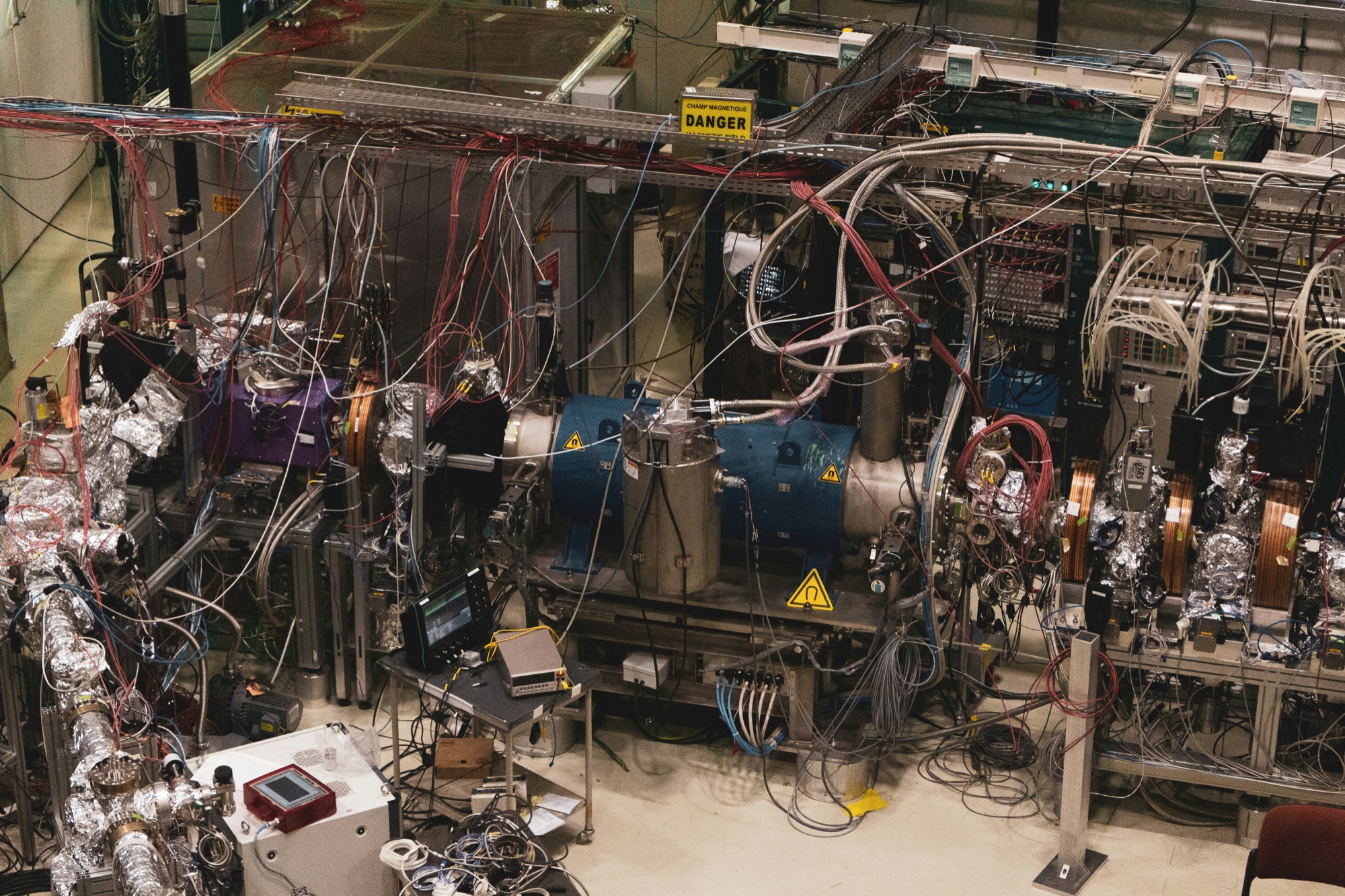
The team used a more selective form of the technique. Polarised neutrons have their own spins aligned, so the way they scatter depends on the orientation of the material's magnetic moments relative to the neutron spins. The researchers also used a domain-biased sample. Magnetic domains are regions where the ordered arrangement takes different orientations, and in this sample they were prepared so that one orientation dominates.
The authors report two findings. First, the magnon spectrum is split, and they attribute this splitting to long-range dipolar coupling, the magnetic interaction between moments that acts over large distances. This means the splitting alone is not presented as the proof. The decisive evidence comes from the domain-biased sample, in which the scattering shows nonzero chirality, or handedness, and that handedness has opposite signs in the two magnon modes. According to the study, this sign reversal is what clearly demonstrates altermagnetism in MnF2.
The abstract gives no energies, temperatures or size of splitting, and it does not say how strongly the domains were biased. Readers therefore cannot judge from it how large the effects are or how easily they can be reproduced. The authors say the result highlights the potential of polarised neutron scattering, through its sensitivity to fine structure in magnon spectra, to characterise altermagnets. How well the approach transfers to other candidate materials lies beyond what the abstract reports.
The work parallels a braintankAI story on manganese telluride, in which polarised X-ray scattering found a spin wave with a definite twist whose spin polarisation varied with momentum, in line with that material's symmetry (earlier story). Both studies identify an altermagnet through the handedness of its spin waves, but each uses a different probe on a different material.
- Paper
- Altermagnetism revealed by polarized neutrons in MnF 2
- Authors
- Quentin Faure, Dalila Bounoua, V. Balédent, Arsen Gukasov, Vasile Ovidiu Garlea, Ana Beatriz Landim Ribeiro et al.
- Venue
- Science · 29 October 2026
- Link
- doi:10.1126/science.aec2602
- Index
- stacks.braintank.ai
- Cite