Ai2's MolmoAct2 is a fully open robot model aimed at low- to medium-cost hardware
A preprint pairs a spatially trained vision-language model with a motion generator and reports strong out-of-the-box results, though its real-world trials are small.
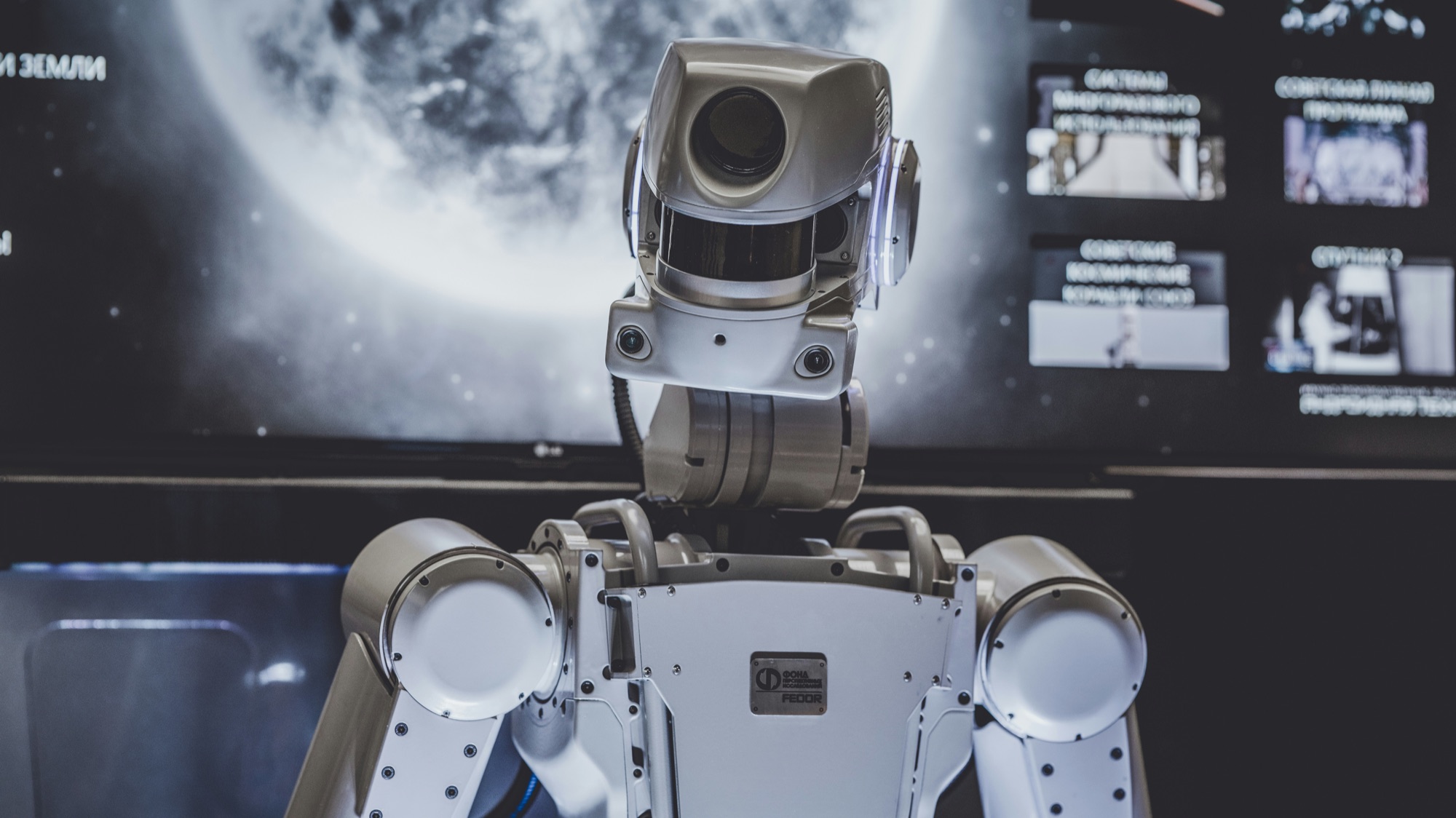
Researchers at Ai2 have released MolmoAct2, a family of vision-language-action models, or VLAs: systems that take camera images and a written instruction and output motor commands for a robot. The work is described in an arXiv preprint that has not yet been peer reviewed. Its distinguishing feature is that it is fully open, with model weights, training code and data all released. The authors test it on seven benchmarks in simulation and the real world, using three robot platforms they describe as low to medium cost.
The authors frame the work around four ways today's robot models fall short of real deployment. The strongest are closed. The few open ones, such as π0 and π0.5, release weights but not data or recipes, and are tied to expensive or specialised robots. Models that reason before moving must generate hundreds of tokens, or whole predicted images, before each action. That is too slow for closed-loop control, in which a robot continually corrects itself against what its cameras see. And success rates, even after task-specific training, remain below what dependable use requires. MolmoAct2 tries to push on all four problems at once, which makes it a useful gauge of where open robot models stand.
How it works
The foundation is a new vision-language model called Molmo2-ER, for embodied reasoning. The team started from a saved snapshot, or checkpoint, of an existing model, Molmo2-4B, and trained it on about 3.3 million examples of physical understanding. These include questions about images and videos of real and simulated scenes, pointing at locations, detecting objects, relating views from several cameras, and abstract reasoning tasks. A long first stage on this data was followed by a short one that mixed the model's original training data back in, in equal measure with the new data, so that its general skills would not be forgotten.
Next, motion has to be expressed as text-like symbols. The authors' tokeniser is an open re-implementation of a method called FAST. It takes an action chunk, meaning one second of future motion, converts it into frequency components, rounds these to discrete values and compresses common patterns into a vocabulary of 2,048 symbols. Pre-training then teaches the model to predict these symbols the way a language model predicts words, with 90 per cent of samples drawn from robot data. That data includes three collections the authors release. The first is 34,500 two-armed demonstrations recorded on a YAM rig costing under $6,000. The second is cleaned-up community recordings from the low-cost SO-100/101 arm, amounting to 38,059 episodes from 377 contributors. The third is a curated subset of DROID, a large dataset gathered on Franka arms. An AI model relabelled the task instructions, roughly doubling the number of unique ones.
Discrete symbols are coarse, so the next stage attaches an action expert. This is a separate 36-layer network whose only job is to produce smooth, continuous motion. It is trained with flow matching, a technique in which a model learns to turn random noise, step by step, into a realistic output, here a trajectory. The expert does not read only the language model's final output. Instead, each expert layer reads the keys and values of the matching language-model layer; these are the internal representations its attention mechanism uses to weigh different parts of the input. During this stage the expert's training signal is blocked from altering the language model, a step called knowledge insulation. A last fine-tuning stage for each robot uses robot data only, lifts the insulation and doubles the flow-matching samples per chunk from four to eight.
A variant, MolmoAct2-Think, adds a reasoning step. Before acting, it predicts a coarse 10-by-10 depth map of the scene, with each cell taking one of 128 codes. It learns this from depth estimated by another model, Depth Anything V2. To save time, it re-predicts only the cells whose image patch has noticeably changed since the last step and reuses the rest from a cache. Both versions are sped up further with CUDA Graphs, a GPU technique that records a repeated sequence of operations once and then replays it.
What the evidence shows
Across 13 embodied-reasoning benchmarks, Molmo2-ER scores best on nine. It also has the highest average, 63.8 per cent, 2.5 points ahead of the runner-up, Gemini-ER 1.5 Thinking; the comparisons also include the GPT-5 family and Qwen3-VL. The new backbone also seems to help action learning directly. LIBERO is a standard simulated manipulation benchmark, and on its long-horizon suite a discrete-action policy built on Molmo2-ER reached 83.6 per cent, against 77.6 for one built on plain Molmo2.
The most statistically solid results come from out-of-the-box tests in simulation, where the model runs with no extra training for the tasks. On the MolmoBot benchmark, with 1,000 episodes per task, MolmoAct2 averaged 20.6 against 10.0 for π0.5-DROID, the strongest baseline. On pick-and-place judged at the final step, however, the two were statistically indistinguishable at 7.8 and 7.6. On MolmoSpaces, averaged over three runs, the lead was narrower at 37.7 to 34.5, and the model lost clearly on opening tasks, scoring 9.5 against 22.7.
Real-world out-of-the-box trials used unseen objects, randomised camera positions and unfamiliar environments. On a Franka arm across five pick-and-place tasks, MolmoAct2 averaged 87.1 per cent, against 48.4 for a MolmoBot policy and 45.2 for π0.5-DROID, with 15 trials per task. On the SO-100, scored with partial credit, it averaged 56.7. That beat 45.3 for a π0 model the authors fine-tuned on their own SO data and 2.3 for SmolVLA. It did, however, lose the block-in-box task by 33.3 to 90.0.
After task-specific fine-tuning, MolmoAct2 averaged 97.2 per cent on LIBERO, just above GR00T N1.7 at 97.0 and π0.5 at 96.9, while Think reached 98.1. On the two-armed YAM, the authors introduced changes to spatial arrangement, lighting, instructions and distractor objects. Under these, MolmoAct2 averaged 50.7 per cent, 10.8 points ahead of the next-best model, OpenVLA-OFT. On RoboEval, a set of eight two-armed tasks, it stacked two blocks in 4.70 seconds against 5.87 for π0.5. Ablations, which remove or swap one component at a time, back the design: on LIBERO, per-layer key-value conditioning scored 95.9 against 94.0 for reading only the final hidden state, the language model's last internal representation. On a single H100 data-centre GPU, caching and CUDA Graphs raised MolmoAct2's effective control rate from 23 to 55.8 Hz. That is actions per second averaged over a ten-step chunk, or about 0.18 seconds per call.
What it does not show
The weak spots are visible in the results. Opening articulated objects, those with hinged or sliding parts, remains a problem: the score of 9.5 on opening tasks trails three baselines. The SO-100 average hides one heavy loss. Real-world samples are small. At 15 trials per task, a single success or failure moves a score by almost seven points, and the robustness study used five trials per perturbation. The authors also ran the baselines in their own setups.
LIBERO is close to saturated, meaning top scores are bunched near the maximum, between 96.9 and 98.1 per cent. A 0.2-point lead there says little, and the conditioning and flow-sample ablations differ by less than two points on that single benchmark. The case for Think is the thinnest. Its benefit is demonstrated on LIBERO, where it adds 0.9 points near the ceiling. The checkpoint used was picked as the best of those saved partway through training, a practice that can flatter small gains.
Reasoning also has a price. Think runs at 12.7 Hz against 55.8 for the plain model. It gains less from CUDA Graphs because its depth decoding is sequential and variable in length. The timings come from a data-centre GPU, not from computers mounted on robots, and fine-tuning for each platform takes about 1,152 to 2,304 H100 GPU-hours. Much of the data also rests on automated tools: a quality score to filter recordings, an AI model to relabel instructions, and depth estimated from single camera images.
Where it fits
MolmoAct2 succeeds MolmoAct, which is itself one of the reasoning-heavy policies the paper calls too slow. A central argument is about openness. Frontier systems such as Gemini Robotics are closed, and π0 and π0.5 publish weights only. Even the tokeniser reflects this: the training distribution behind FAST was not fully specified, so the authors rebuilt it and released its training data. Per-layer conditioning is pitched against the shallower approach of passing the expert only the final hidden state, and the paper tests the two head to head.
On reasoning, the paper groups several approaches whose reasoning, it argues, improves action quality but dominates inference time. These include MolmoAct, CoT-VLA, models that draw predicted motion traces, and world-model policies such as Cosmos Policy, which roll out future frames. Think's bet is that reasoning becomes cheap if only what has changed is updated. On this evidence the bet is plausible but unproven. Think runs at about a quarter of the speed of the authors' own non-reasoning model, and its gains are small.
As the opening story in this series, MolmoAct2 also sets out the deployment bar that later stories will return to. Openness here is concrete. Hardware cost is addressed through low-cost arms and a sub-$6,000 two-armed rig, though training still demands heavy data-centre compute. The plain model's speed answers the latency complaint, at least on an H100. Dependable success is not yet demonstrated. The model scores strongly on pick-and-place in one setup, succeeds in about half of attempts under perturbation, and averages 20.6 on MolmoBot's simulated tasks.
- Paper
- MolmoAct2: Action Reasoning Models for Real-world Deployment
- Authors
- Haoquan Fang, Jiafei Duan, Donovan Clay, Sam Wang, Shuo Liu, Weikai Huang, Xiang Fan, Wei-Chuan Tsai, Shirui Chen, Yi Ru Wang, Shanli Xing, Jaemin Cho et al.
- Venue
- arXiv preprint — not yet peer reviewed · 4 May 2026
- Link
- arxiv.org/abs/2605.02881
- Index
- stacks.braintank.ai
- Code
- github.com/allenai/molmoact2
- Cite